


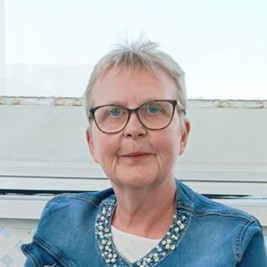
Sara Beamand
Non-Executive Director
In March 2025, Sara Beamand became the seventh member of Sustain UK’s board of Non-Executive Directors. Four months on, we caught up with Sara to hear more about her journey in housing, what drew her to Sustain UK, and why she’s optimistic about the future of supported housing.
Absolutely. I began my career back in the 1980s with a large Midlands-based housing association, spending over three decades working in housing, care and support. I eventually became the Director of Care and Support, where we provided services for everyone from mental health and homelessness to older people and learning disabilities.
Around 2015, like many large housing associations, there was a decision to step away from care and support due to the risk and complexity. Since leaving in 2016, I’ve run a small consultancy focused on care, support, and safeguarding. My background has always been rooted in delivering quality services to vulnerable people, and that’s still where my passion lies.
I was initially hesitant as I understood the challenges the exempt sector faces. But after reviewing Sustain’s action plan and seeing how closely they were working with the regulator, I was genuinely impressed. They’ve taken real steps over the years to reset and build strong foundations in very challenging times.
I was struck by the openness of the board, Ian as well as the senior management team during the interview process; there was a real sense of purpose.
Rather than hiding from the challenges faced by supported housing, Sustain UK is meeting them head-on, and that awareness, honesty, and ambition to do better really resonated with me.
The sector faces a perfect storm of challenges: reduced funding, rising need, and a lack of coordination between housing, health and social care. Services that used to work, mental health, learning disability support and social care have been hollowed out by years of cuts.
At the same time, some providers have entered the sector for the wrong reasons, exploiting funding rules rather than supporting people.
That’s created mistrust and increased pressure on the regulator. All of this has led to gaps in services and real risks to vulnerable tenants who are falling through the cracks.
Most importantly, it is to offer strategic oversight and ensure robust and independently minded governance. That means asking the right questions, holding the executive team accountable, and ensuring we deliver not just financially, but also ethically and responsibly.
I have a particular focus on care and support quality, safeguarding, and regulatory compliance. It’s also about making sure tenants are getting the support they need, and where services fall short, we push for improvements or move on from poor providers. Essentially, I help ensure that we’re always acting in the best interests of residents.
Strong, independent governance is particularly important when working with vulnerable people. It’s about having the right checks and balances, ensuring the organisation is financially sound, managing risk well, and, most importantly, keeping residents safe.
When governance is weak, corners can get cut and standards slip. A well-governed board isn’t afraid to challenge decisions, hold up a mirror, and ask tough questions.
It’s that scrutiny that keeps things honest and focused on quality and compliance. Ultimately, it protects both the organisation and the people we’re here to support.
We need more joined-up working with councils, ring-fenced funding, and a clear national strategy.
It’s about separating the good from the bad and creating a sector that’s focused on people, not just property or profit.
Part of this includes seeing a stronger inspection programme. I know Sustain does at least four checks a year on each property, which is already way above average. But the truth is, the more often homes are inspected, the better it is for residents. It means issues get picked up and sorted faster, and that just makes for a better place to live.
Improved levels of collaboration between local charities and agencies can also make a big difference. Some of the supporting organisations bring a lot of experience to the table, and when we work together, it really shows.
One great example is the DWP’s recent Moving On project, which is all about helping people move on from supported housing and take that next step toward independence.
Sustain was proud to play a part by offering free accommodation, and The Salvation Army were fantastic too, they provided classroom sessions and hands-on support to help people feel confident in managing their own tenancy. It just goes to show what’s possible when everyone pulls together for the benefit of the people we’re here to support.
And just one more thing - I’d really like to see more people coming into this sector because they care. We need people who genuinely want to do the right thing, not those who see supported housing as just another way to make money.
Sustain has built a strong infrastructure and maintains solid governance practices. They’re working closely with the regulator, reviewing providers, and putting in new systems for clearer oversight.
There’s a strong culture of accountability from the board down. But the challenges are bigger than one organisation.
With the changes coming through the Supported Housing Bill, and the talk of new national standards, it really feels like we could be at the start of something better. A chance to finally crack down on the poor providers who are giving the good ones a bad name.
After seeing the work happening behind the scenes at Sustain, I definitely feel more confident. There are people out there who care, who are putting in the effort, and who have the right mindset to offer proper support and do things the right way.
So, I’m feeling hopeful. Hopefully, over the next few years, we’ll start to see real, positive changes in supported housing, not just here in Birmingham, but right across the UK.
If you’d like to know more about Sustain UK’s other board members, visit our About Us page.